My Go-To Genealogy Trick for Relatives Who “Disappear”
Every genealogist eventually encounters the same problem. A person who is well documented suddenly vanishes from the record. There is no death record, no clear relocation, and no obvious explanation. The paper trail simply stops.
In many cases, the explanation is routine. People changed jobs, divorced, or moved quietly to a new place. In other cases, the reasons are more complex. Some individuals deliberately left their past behind, adopted new identities, or avoided being found.
I have solved this type of case more than once using a record that is often overlooked in U.S. genealogy: the Social Security application, also known as the SS-5. This approach applies only to individuals who lived long enough to apply for a Social Security number after 1936. When it applies, it is one of the most reliable tools available for reconnecting identities.
Why the SS-5 Form Is Genealogical Gold
When the Social Security program began in the mid-1930s, applicants were required to complete a detailed form. This was not a casual document. It collected key identifying information, including full name, date and place of birth, parents’ names, and current employment details.
From a genealogical perspective, the most important fields are the parents’ names. These often remain consistent even when other details change.
A pattern appears repeatedly in these records. Individuals who reinvented themselves under a new name often still reported their parents with reasonable accuracy. The details are not always perfect, but they are usually close enough to reveal the connection.
The pattern tends to look like this:
The mother’s first name and maiden name are usually correct
The father’s first name is often correct or close
The father’s last name is altered to match the alias being used by the applicant
That small inconsistency becomes the key to identifying the person.
A Criminal Reinvention: Edward Lee Copeland
While researching my book The Solomon Gang: Outlaws by Any Name, I ran into this exact pattern with Edward Lee Copeland. He did not simply disappear. He had been involved in criminal activity in Colorado and had strong reasons to leave and start over.
His initial alias that he used during his crime spree and while in prison was Ed Solomon. However, around 1908 after his parole, he vanished from the records in Colorado. Decades later, he appeared in California under the name Lee Edwards. But I had no clear connection between the outlaw and the later identity.
I found the answer once I found his 1937 Social Security application - by searching the records for his mother’s name.
He listed:
Mother: Lucinda Anderson
Father: Alfred J. Edwards
Lucinda Anderson was correct, aside from a minor transcription issue seen below. The father’s first name was close enough to the real name, Alpheus. The critical detail was the surname he created for his father. “Edwards” was not his father’s surname (Copeland was). And this signaled to me that he changed his name again.
By aligning his father’s surname with his alias, he created a consistent identity on paper. At the same time, he preserved enough truth to expose the connection decades later.
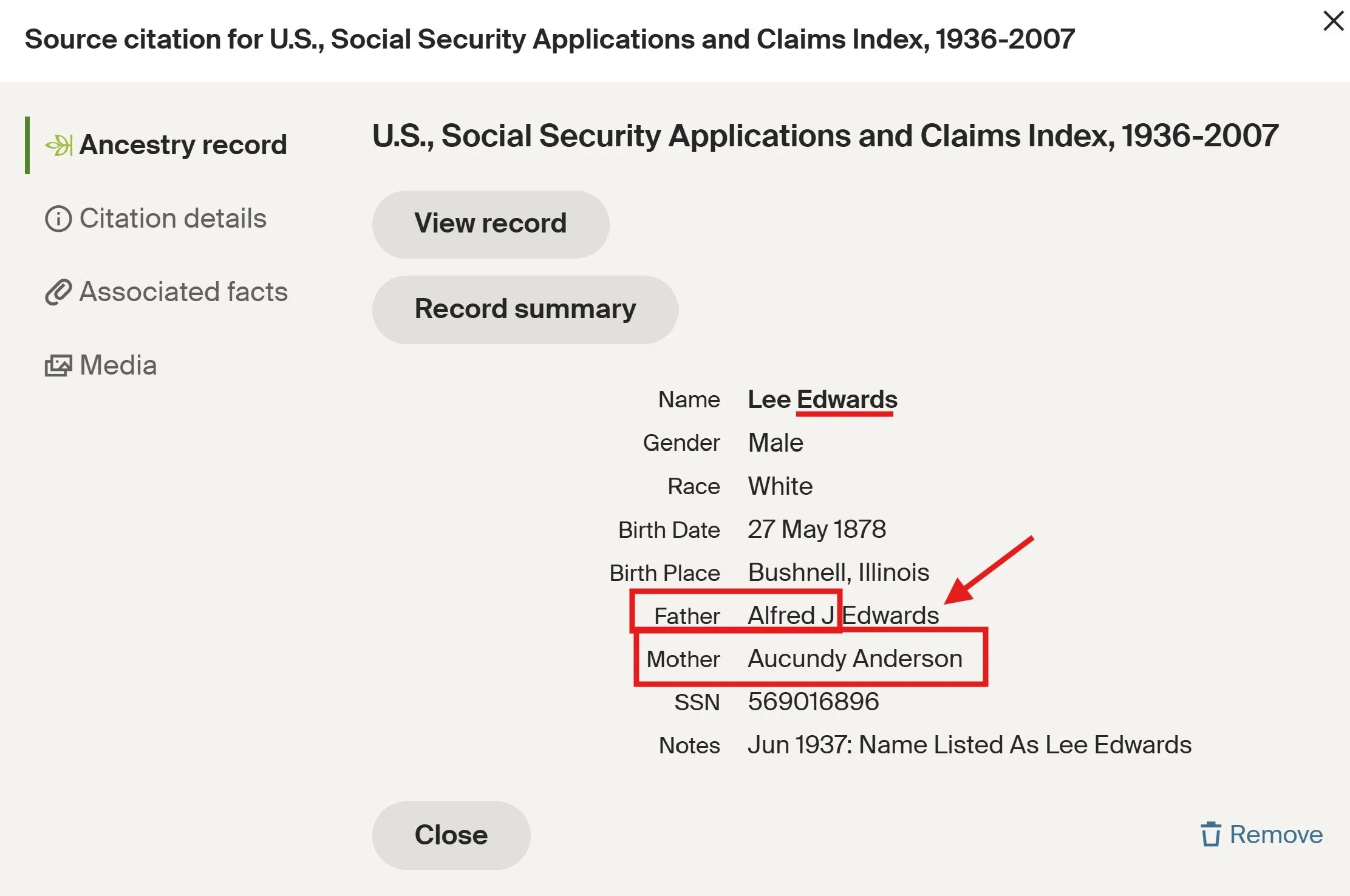
Lee Edwards (Edwards is the alias last name)
Mother’s name is accurate except for a transcription error
Father’s last name is now the alias last name
A Second Case, Same Pattern
I observed the same behavior in another case involving a man who left his family in the early 1920s and reappeared in another state under a new identity. His family believed he had disappeared permanently.
His SS-5 told a different story. The mother’s maiden name was accurate (that’s how I found him - searching by the mother’s name), and the father’s first name matched the original identity. However, the father’s last name had been altered to match the alias the man was using.
This creates a subtle but revealing inconsistency. The surname is adjusted to fit the new identity, while the rest of the parental information remains anchored to reality. Once you recognize this pattern, the connection becomes clear.
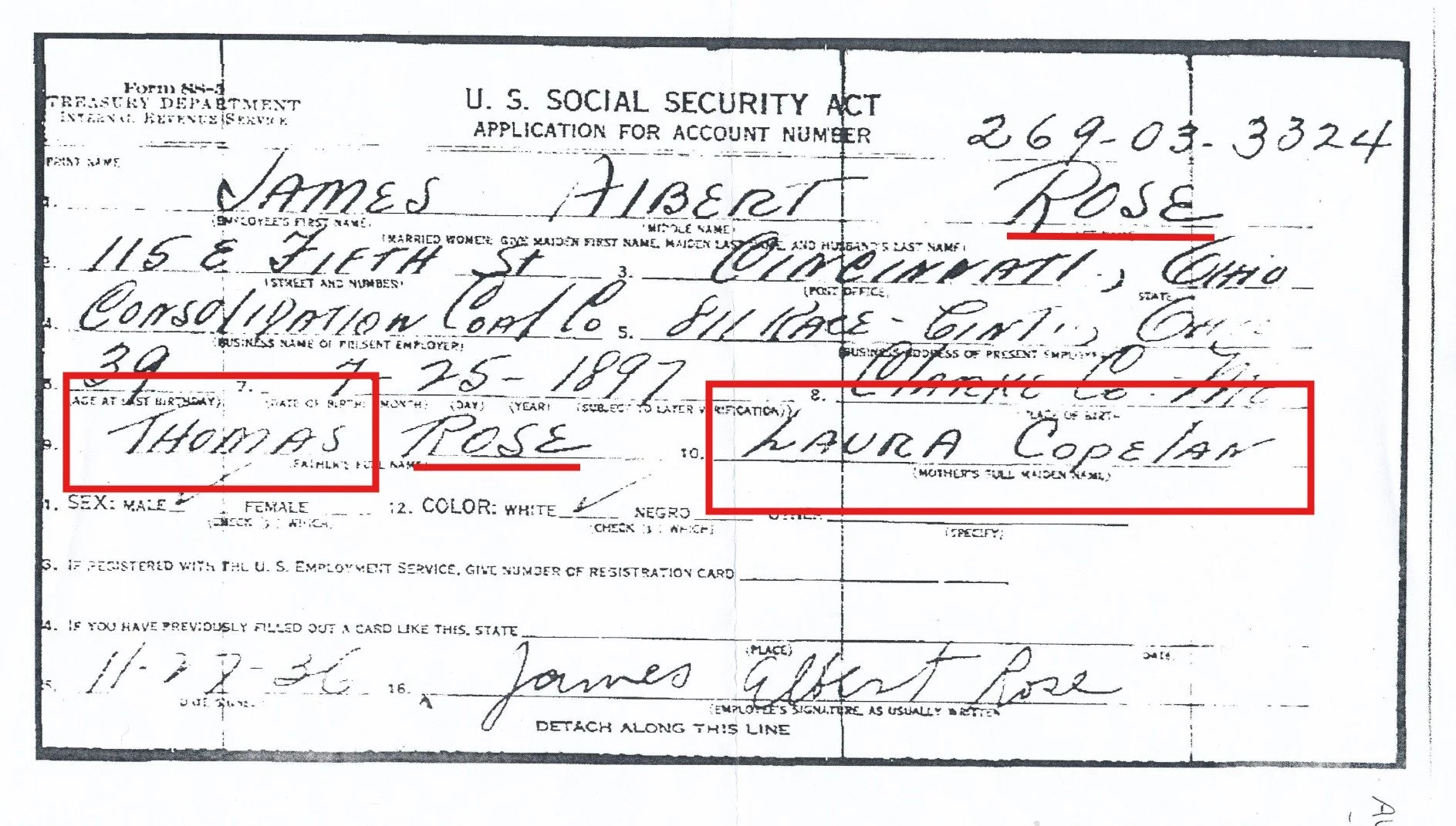
Rose is the alias last name (the individual also changed their first name completely).
Thomas is the father’s real first name, and Laura Copelan is the mother’s real maiden name
Rose has been added to the father’s name to match the alias
Why This Works So Well
People can change their names, relocate, and build entirely new lives. However, when asked about their parents, most individuals rely on memory and belief. Those details tend to remain stable, even when other parts of their identity change.
This partial consistency creates a bridge between identities. It allows genealogists to reconnect records that would otherwise appear unrelated.
One important caution is that the adopted surname does not always come from the father. It may come from a mother, stepfather, acquaintance, or an unrelated source. It is necessary to evaluate each case broadly and avoid narrow assumptions.
When to Use This Strategy
If a person in your tree appears to disappear and lived into the Social Security era, this method is worth applying. Focus on locating:
The original SS-5 application
Early Social Security claims
Any later corrections or amendments
And search for combinations of the mother’s name and father’s name
These records may reveal that the individual did not disappear at all. They simply changed identities and left a trace behind in a government form.
Need Help Untangling a Disappearance?
These are the cases I love most. Criminal pasts, second lives, and identities that fracture and rejoin through records.
If you need help with a disappearance in your own tree, I offer professional genealogy and DNA analysis services.
