Using Ancestry ThruLines to Spot Family Mysteries
One of my favorite ways to use ThruLines on Ancestry is not to confirm what I already know, but to spot what is missing.
ThruLines can be incredibly powerful. But when something does not line up, that is often where the real research begins.
The Setup: Looking at One Ancestor’s Children
Let me walk through a real example.
I pulled up my ThruLines for one ancestor, Solomon Anderson. Ancestry showed:
5 children
DNA matches grouped under each of those children
At first glance, this looks neat and complete. But I already knew something important.
Based on documented records, I know Solomon had:
8 confirmed children
Possibly another 3 additional children who have not yet been fully identified
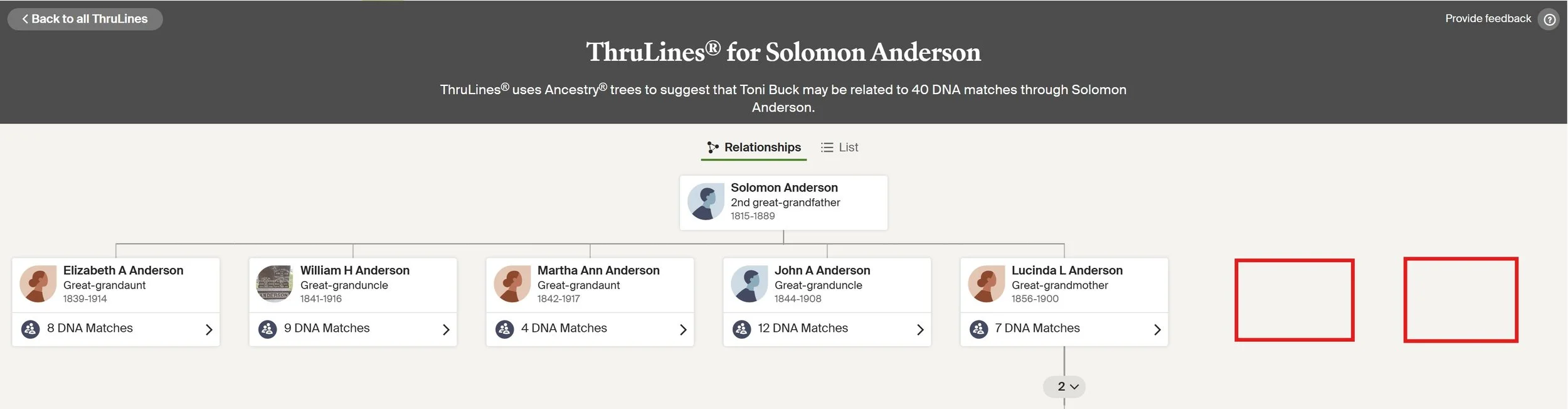
ThruLines for Solomon Anderson - Missing Children
So the obvious question is:
Why are only 5 children showing up in ThruLines? That gap is not automatically an error. It is a clue.
Why Children May Be Missing from ThruLines
ThruLines relies heavily on two things:
DNA test takers
Other members’ family trees
When children are missing, there are several common explanations.
1. Weak or Incorrect Trees
If other researchers have not:
Built trees for those children
Correctly attached those children to the parent
Or linked DNA matches properly
Then ThruLines has nothing to work with. Poor or incomplete trees often result in missing ThruLines.
2. No DNA Matches (Yet)
Sometimes there is no mystery at all.
That child’s line may have died out
Or living descendants simply have not tested
ThruLines can only display what exists in the DNA database today.
3. A Genuine Family Mystery
This is the scenario that gets my attention.
Missing children can point to:
Non-paternity events
Adoptions
Informal name changes
Children raised in another household
Entire lines that were never properly documented
These are often solvable, but they require deeper research.
4. The Paper Record Does Not Match the DNA
Occasionally, children who appear in the historical record are not biological descendants of the presumed parent. That does not mean the records are wrong. It means the family story may be more complex than it appears on paper.
Why Missing ThruLines Matter
When a child is missing from ThruLines, it warrants closer investigation.
This is where your research time is best spent:
Researching each child independently
Building solid, documented descendant trees
Verifying spouses, locations, and timelines
Following those lines forward to the present
Once the research is strong, the next step is outreach.
The Final Step: Find the Living Descendants
After building accurate trees:
Identify living descendants
Reach out through Ancestry messages, social media, or genealogy groups
Ask whether they have tested, or are willing to
Many breakthroughs happen after this step, not before it.
The Big Takeaway
ThruLines is not just a confirmation tool. It is a diagnostic tool.
When children are missing:
Do not ignore it
Do not assume Ancestry is wrong
Treat it as a research prompt
Some of the most interesting family discoveries begin with one simple question: “Why isn’t this line showing up?”
Need Help Solving a ThruLines Mystery?
If you are seeing missing children, unexplained gaps, or confusing ThruLines results and want professional help, I can assist. I work with DNA matches, descendant research, and complex family mysteries to determine why a line is not appearing and what to do next.
If you would like additional professional help with your own research, email me at: thetechnicalgenealogist@gmail.com
