Best Practices for Tree Hygiene During DNA Research
Once you understand why tree structure matters for DNA analysis, the next question is practical: how do you maintain that structure while actively working a DNA case?
Regardless of whether you use one tree or multiple trees, a few consistent habits can reduce confusion and make Ancestry’s DNA tools far more useful. These practices are less about choosing the “right” conclusion and more about keeping your tree interpretable while questions are still unresolved.
Choose public or private settings intentionally
Tree privacy settings directly affect how Ancestry’s systems and other researchers interact with your work.
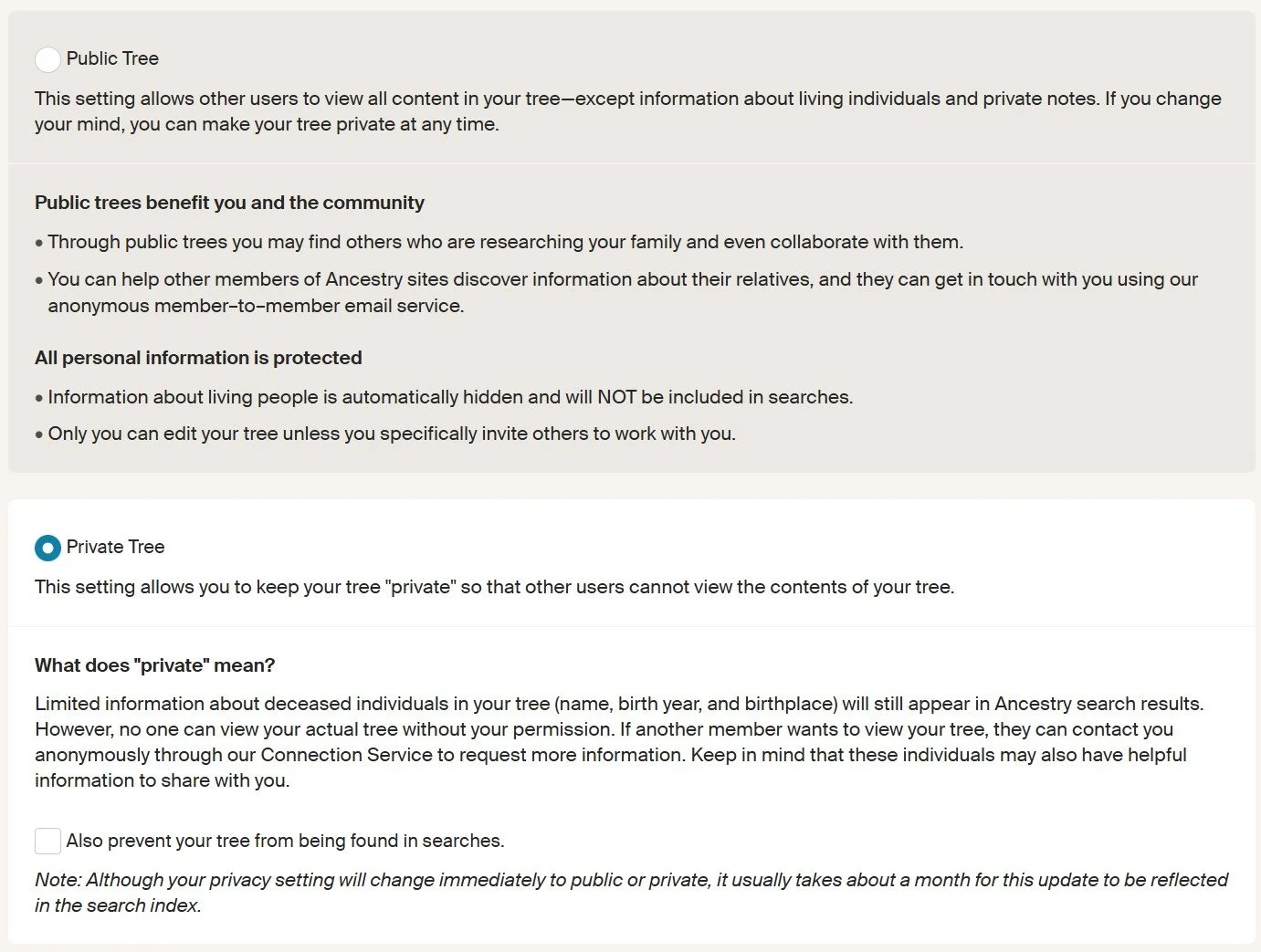
Tree setting options
Public trees are visible to other users, with living individuals and private notes hidden by default. From a DNA perspective, public trees tend to work more smoothly with tools like ThruLines and Common Ancestor hints because the tree structure can be compared across many trees.
Private trees still function with DNA matches, but the specific settings matter. When you make a tree private, Ancestry also gives you the option to exclude that tree from search results. When that option is enabled, the tree becomes largely invisible to Ancestry’s discovery systems. As a result, it may be used less often when building ThruLines or shared ancestor paths.
If you prefer to keep a tree private while still benefiting from Ancestry’s DNA tools, consider leaving the “prevent your tree from being found in searches” option unchecked. This allows limited indexing while preserving control over who can view the full tree.
The key point is intentionality. Privacy choices are not neutral. They influence how often and how effectively your tree participates in DNA-related features.
Keep guesses and trial relationships in separate research trees
DNA research almost always involves testing ideas.
You may want to attach a potential biological parent, explore a new surname, or see whether a cluster begins to align with a hypothesis. Doing this work directly in a fully documented tree can quickly blur the line between evidence and experimentation.
A separate research or hypothesis tree solves this problem. These trees should be clearly labeled to reflect their purpose. They protect your main tree from speculative relationships and make it easier to undo or revise ideas as new evidence appears.
For research trees, privacy is usually the better choice. Keeping them private reduces the risk that trial relationships will be mistaken for conclusions and copied into other trees.
Even so, clear labeling still matters. If the tree is shared with a collaborator or appears through limited indexing, it should be obvious that it represents active analysis, not a settled result.
Maintain consistency as the tree evolves
Trees that mix biological, social, and speculative relationships require regular review.
Small structural decisions can have large downstream effects. A single misplaced parent-child relationship can influence multiple ThruLines, generate misleading Common Ancestor hints, or cause DNA matches to appear more closely or more distantly related than they actually are.
Ancestry’s DNA tools assume internal consistency. They do not evaluate whether a relationship is proven, probable, or speculative. They simply follow the paths that exist.
When relationships are clearly defined and intentionally structured, the tools can generate useful hypotheses. When they are not, the tools still produce output, but interpreting that output becomes significantly harder.
Structure supports interpretation
Tree hygiene is not about hiding uncertainty or choosing sides between records and DNA. It is about making uncertainty visible in a controlled way.
Well-maintained trees allow you to ask better questions of your DNA data. Poorly structured trees force you to untangle algorithmic noise before you can evaluate real evidence.
DNA tools do not fail when trees are messy. They behave exactly as designed. Clear structure makes their behavior predictable.
In the next article, I will walk through practical examples of how tree structure affects ThruLines and Common Ancestor hints, and how to diagnose problems when those tools begin pointing to the wrong families.
If you are working through a DNA case and want help interpreting matches, identifying biological parents, or restructuring a tree so Ancestry’s DNA tools work more effectively, I offer professional DNA match analysis services.
