Proving a Connection to the “Blue Fugates” of Kentucky
Some genealogy cases are satisfying. Others are memorable. This one was both.
Recently, I worked with a client who believed they were descended from the famous Blue Fugates of Kentucky. Not just a Fugate family from Kentucky, but the specific family historically documented for its blue skin caused by hereditary methemoglobinemia. Few American families are as visually striking or as frequently referenced in medical and social history, which immediately made this case unusual and compelling.
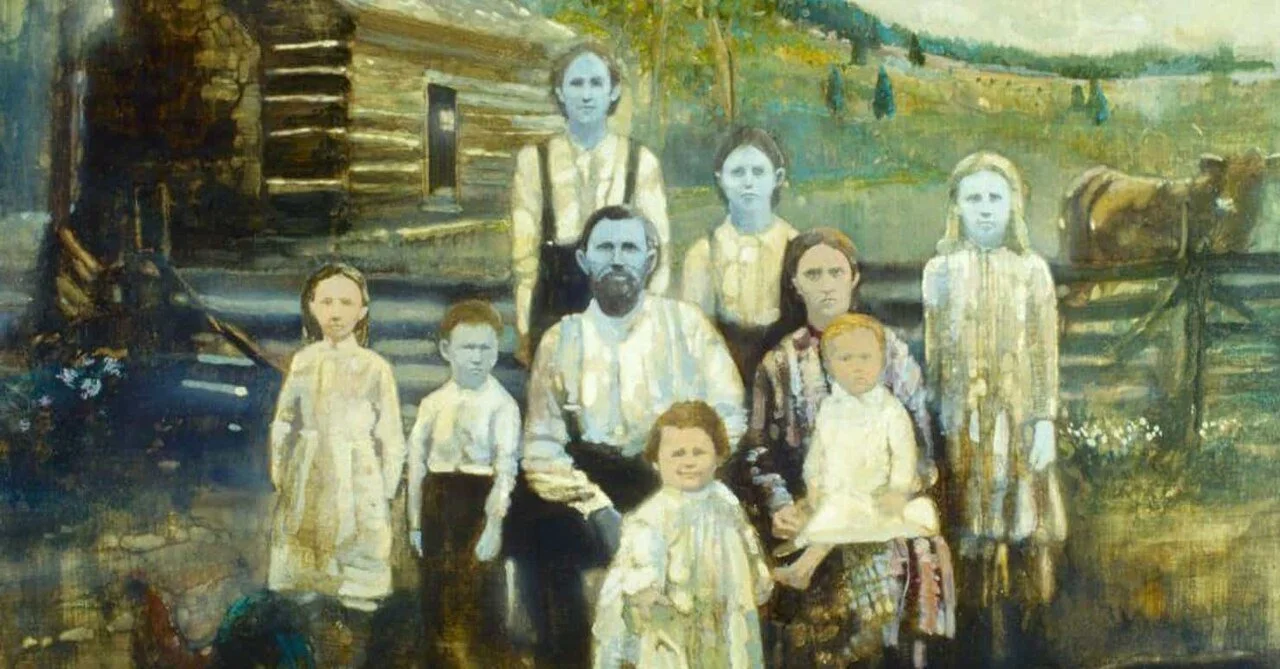
Image credit: Painting of the Blue Fugates of Kentucky, via Wikimedia Commons. Licensed under Creative Commons Attribution 4.0 International (CC BY 4.0).
Source: https://commons.wikimedia.org/wiki/File:Painting_of_the_blue_fugates_of_kentucky.jpg
If you are unfamiliar with the history, the Blue Fugates are unusually well documented in both popular history and medical literature. Two solid background references are the Wikipedia overview and a detailed article from All That’s Interesting:
https://en.wikipedia.org/wiki/Blue_Fugates
https://allthatsinteresting.com/blue-fugate-family-of-kentucky
The Research Question
The goal of this project was not simply to build a Fugate family tree. It was to determine whether the client’s lineage actually intersected with the historically recognized Blue Fugate family, rather than one of the many unrelated Fugate branches found in Kentucky. That distinction matters, especially when a family story has been repeated for generations and treated as fact.
Working Without DNA
In this case, I did not have DNA to work with, and that limitation matters. Without DNA, I cannot prove a biological connection in the scientific sense. What I can do is evaluate whether a documented genealogical line intersects with a known, published pedigree using historical records (below).
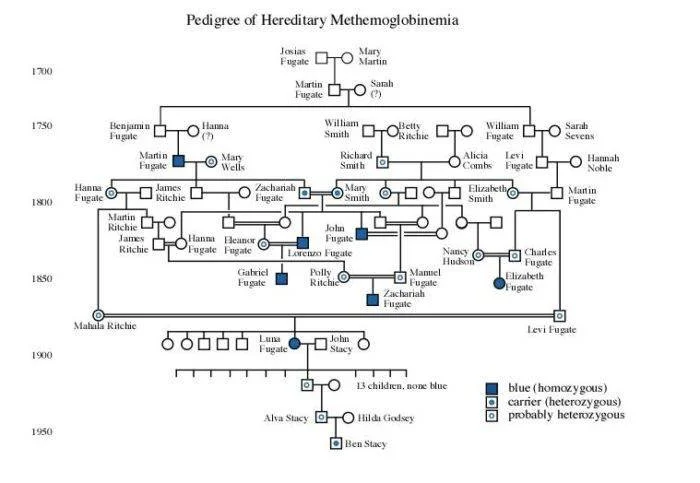
Pedigree of hereditary methemoglobinemia in the Fugate family, originally published in a Fugate family newsletter. Image reproduced via All That’s Interesting.
Source: https://allthatsinteresting.com/blue-fugate-family-of-kentucky
Using census records, vital records, land records, and extended family reconstruction, I built the client’s tree backward one generation at a time. Associates, neighbors, and collateral relatives were just as important as direct ancestors, because families like this rarely leave clean, isolated paper trails.
The Census Problem
One of the biggest challenges in this case involved the census. While tracing the family through the early 1900s, two key individuals were completely missing from both the 1910 and 1920 census. There was strong evidence the family remained in the same town, yet repeated searches under the expected surname produced nothing.
The breakthrough came only after letting go of the assumption that the children would be listed under their parents’ surname. By manually browsing census pages for nearby relatives, the missing individuals finally appeared. They were living in a close relative’s household, listed under that family’s surname, and recorded using nicknames rather than their formal given names. Once they were located, the surrounding records aligned cleanly across time. I describe this exact problem and method in more detail in a separate article.
Connecting to the Blue Fugate Pedigree
With the census gap resolved, the research could continue with confidence. Using consistent documentary evidence, the client’s lineage eventually intersected with a known individual shown in a published pedigree of the Blue Fugate family. The image shared above is a published pedigree documenting descendants of the original Blue Fugate family, and the client descends from one of the individuals shown in that tree.
This does not prove that the client carries the genetic condition associated with the Blue Fugates. It does demonstrate a documented genealogical connection to the historically recognized family, which was the research goal for this project.
Why This Case Was So Enjoyable
This case brought together many of the reasons I enjoy genealogical research. Progress came not from a single document, but from changing assumptions, following extended families, and treating records as clues rather than final answers. It was also a rare opportunity to work with a truly unusual historical family. Researching a lineage tied to the Blue Fugates of Kentucky meant engaging directly with a medical and social history that is unlike almost any other. The image of a family literally remembered for its blue skin is striking, but the real satisfaction came from grounding that story in careful, responsible analysis.
Every Family Has a Story
Every family has a story. Some are passed down quietly through generations, while others are repeated so often they begin to feel unquestionably true. Not every story involves ancestors who were literally blue, but many families carry claims of connection to a famous name, a distinctive group, or an unusual chapter in history that has never been carefully examined.
If you have always heard that your family is related to someone well known, the only way to know is to prove it with records. If you would like help evaluating a family story using careful, evidence-based genealogy, you can learn more about my professional research services.
