Why Linking Your DNA to Your Tree Matters
One of the most common things I see while working DNA cases for clients are DNA matches who are clearly trying to identify biological family, but their DNA test is not linked to a tree, or the tree is completely private and hidden from searches. What Ancestry users don’t realize is that sometimes I inadvertently end up solving a match’s family mystery as I’m working on my client’s tree! A two-for-one!
In many cases, it becomes obvious that many DNA matches may not know one side of their family. Sometimes they were adopted. Sometimes there is an unknown parent or grandparent. Sometimes there was an NPE somewhere in the line. But by leaving the DNA unlinked or hiding the tree completely, they unintentionally make it much harder for both Ancestry and other researchers to help them connect the dots.
Most people think DNA testing works by simply taking a test and waiting for Ancestry to tell them the answer. In reality, many breakthroughs happen because thousands of other people are collectively building trees, researching shared ancestors, hiring genealogists, uploading records, and solving overlapping family mysteries. Every linked public tree becomes part of that larger network.
I have worked cases where the clues needed to solve someone’s mystery were already sitting inside the trees of distant cousins who had been researching the family for years. Sometimes another genealogist working an entirely different case has already reconstructed the branch you need. Sometimes a search angel recognizes a surname or cluster of matches immediately. But those connections become much harder to make when a DNA test is not properly linked to a searchable tree.
A common misunderstanding is that making your tree public exposes information about living people. On Ancestry, that is not how it works. Living individuals are automatically hidden from public view. Other users cannot see their names or details. What becomes visible are deceased ancestors and the structure of the tree itself, which is exactly what helps researchers and DNA matching systems identify connections.
Linking your DNA to the correct tree is extremely important. After building a tree, you need to make sure your DNA test is attached to that tree and that you identify yourself correctly within it. I see many DNA matches where, for example, the match is clearly a young male but the home person in their tree is a middle-aged woman. Make sure to check who you are in the tree! This helps Ancestry’s matching algorithms work more effectively and improves tools like shared ancestor hints and ThruLines.
If you want to adjust your settings on Ancestry, you can go to: Tree Settings → Privacy Settings
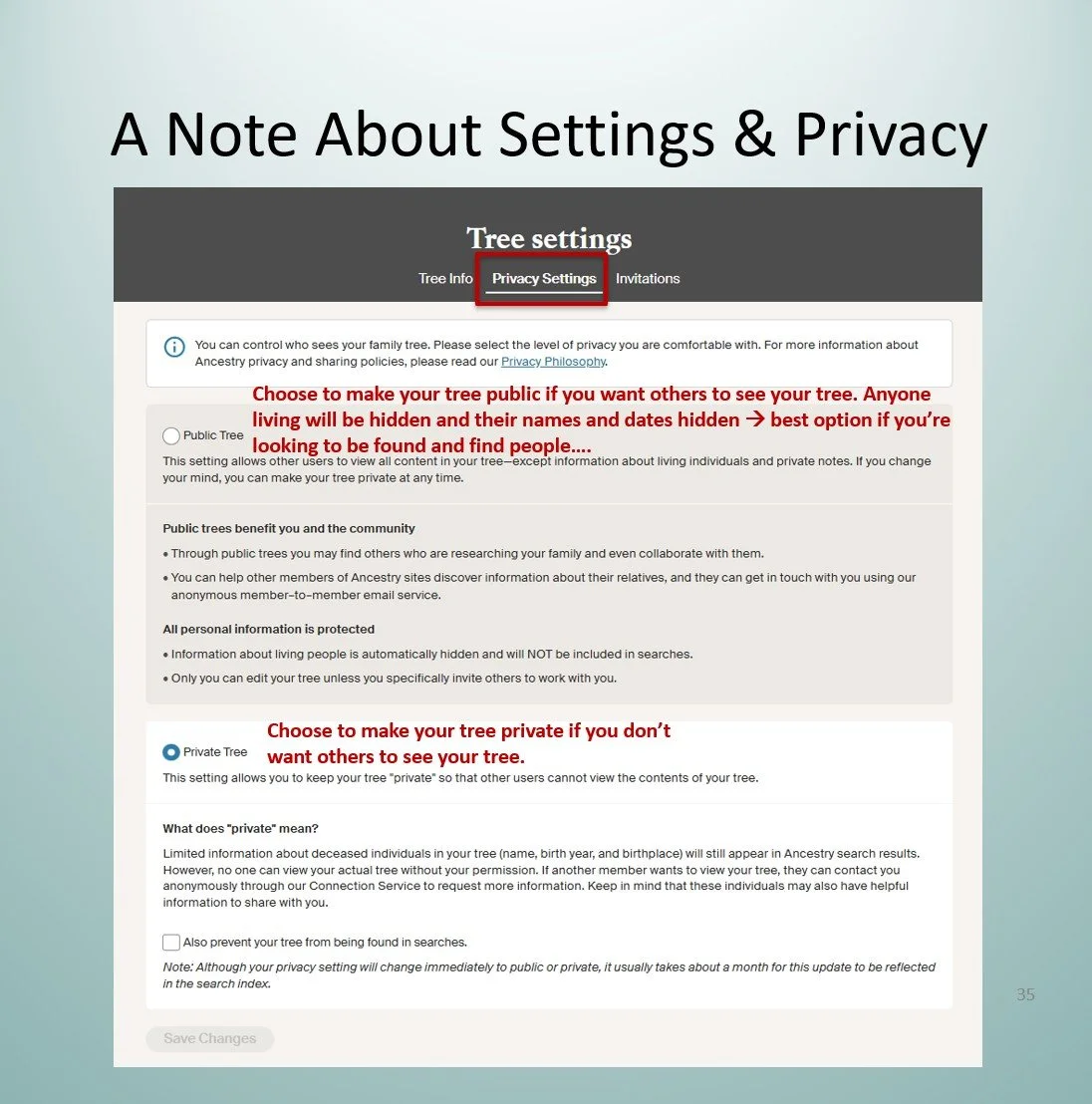
From there, you can make your tree public while still keeping living people hidden. You can also allow the tree to appear in searches, which is often one of the most helpful settings for DNA research.
Many family mysteries are not solved by one dramatic breakthrough. They are solved because hundreds or thousands of people unknowingly contribute small pieces to the same puzzle over time. A linked, searchable tree gives those connections a chance to happen.
I cover DNA tree setup, linking your DNA correctly, shared matches, clustering, and practical family-identification workflows step-by-step in my guide: DNA Doesn’t Lie: How to Find the Family You’re Looking For
