STOP ASKING AI TO “SEARCH” FOR YOUR ANCESTORS!!!
Let’s just say it plainly, because this one comes up constantly.
STOP asking AI chatbots like ChatGPT, Gemini, Perplexity, or Grok things like: “Can you find John Smith born in 1763 in New Bedford, Mass?”
No. It cannot. That is not how this works.
AI CHATBOTS ARE NOT SITTING IN ANCESTRY TYPING FOR YOU
These tools are not quietly in the background:
Opening Ancestry
Typing in your ancestor’s name
Clicking search
Handing you a neat little record
That would be convenient. That is not what they do. AI chatbots do not interact with websites like a person. They are not clicking into search fields, submitting forms, or pulling results out of genealogy databases in normal use.
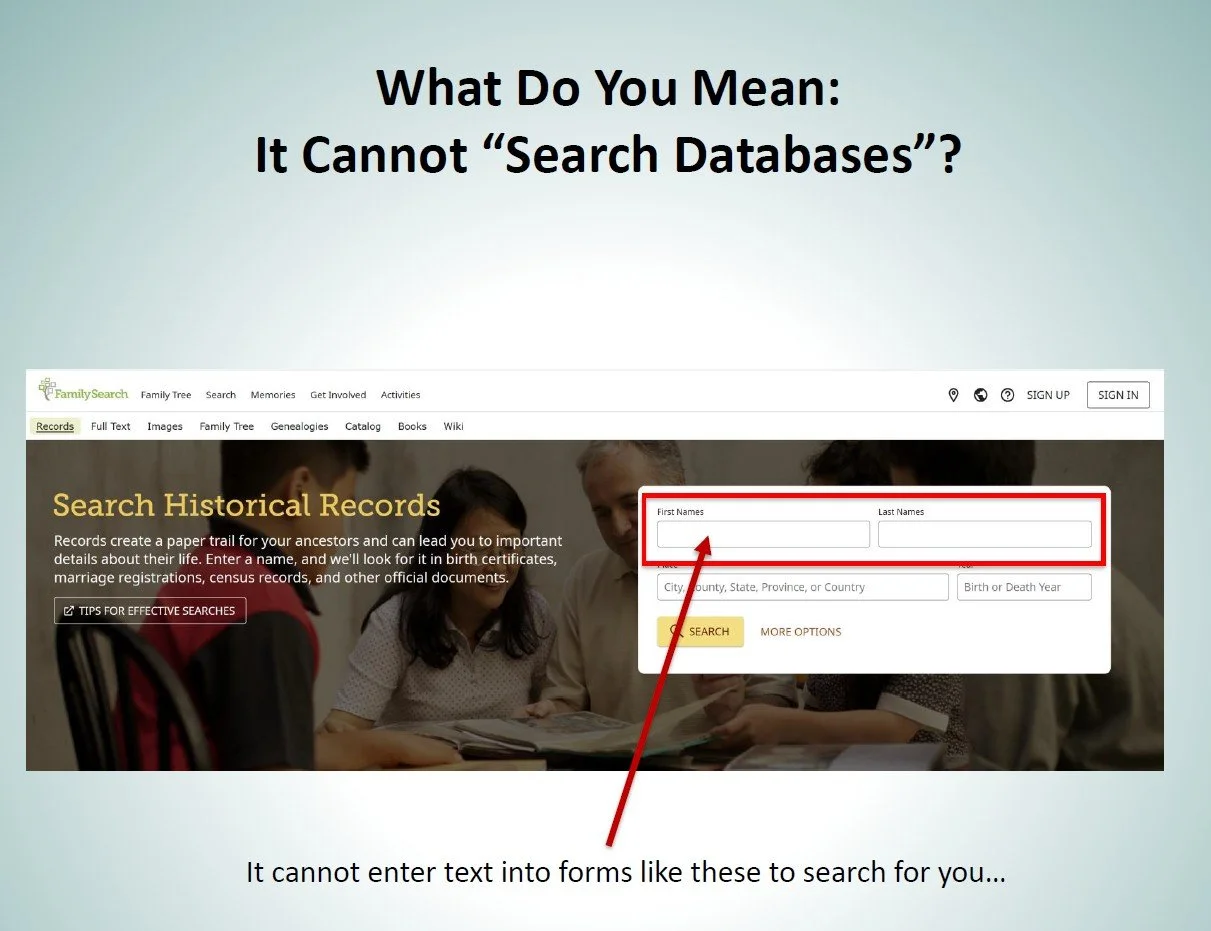
This is a page from my research guide “Fast Start Guide - Using AI for Genealogy” available: https://www.technicalgenealogist.com/shop
AI chatbots cannot:
Log into Ancestry, MyHeritage, Newspapers.com, or Fold3
Access records behind paywalls or subscriptions
Enter names into search fields and return real results
Query structured genealogy databases
Note: Some advanced AI agents can click, type, and navigate websites like a user, but these tools are still early, require setup and permissions, and are not how most people are using AI for genealogy today.
AI DOES NOT HAVE ACCESS TO PAYWALLS
Anything behind a login or subscription is off limits. AI does not have credentials, subscriptions, or accounts to access those systems.
Note: Some advanced systems can operate inside logged-in environments if you explicitly give them access, but that requires configuration and is not how standard chatbots work.
AI DOES NOT “LOOK THINGS UP”
This is the part that trips people up. When you ask a chatbot to “find” your ancestor, it is not searching records in real time. It is generating a response based on patterns and general knowledge, not retrieving an actual census, birth record, or obituary.
So when you ask:
“Who were the parents of John Smith born 1763?”
What you are really asking is:
“Please give me something that sounds right.”
And sometimes it will. That does not make it correct.
AI CANNOT SEE YOUR SCREEN, YOUR TREE, OR YOUR MATCHES
AI chatbots cannot see:
Your Ancestry tree
Your open browser tabs
Your DNA matches
Anything on your screen
They only know what you type or upload.
Note: Some newer “computer use” or agent tools can see and control a screen with permission, but these are experimental, require explicit setup, and are not part of normal chatbot use.
THIS IS NOT A GENEALOGY PROBLEM, IT’S A TOOL PROBLEM
Genealogy requires records, context, and evidence. AI cannot skip those steps, and it cannot magically connect people based on a name, a date, and a place. Neither can a human. If it were that easy, none of us would have brick walls.
WHAT AI CHATBOTS ARE ACTUALLY GOOD AT
AI is not a search tool. It is an analysis tool.
Used correctly, it can:
Break down records you already have
Pull out details you might miss
Summarize confusing documents
Help interpret handwriting or wording
Build timelines and compare evidence
Suggest research strategies and next steps
That is where it becomes useful.
USE THE RIGHT TOOL FOR THE JOB
If your goal is to find a record, check if something exists, or search for a person, use a search engine or go directly to the genealogy database. If your goal is to understand a record, organize your research, or figure out what to do next, that is where AI helps.
THE SIMPLE WAY TO REMEMBER THIS
GOOGLE FINDS THINGS. AI ANALYZES THINGS.
Flip those, and you will get frustrated fast.
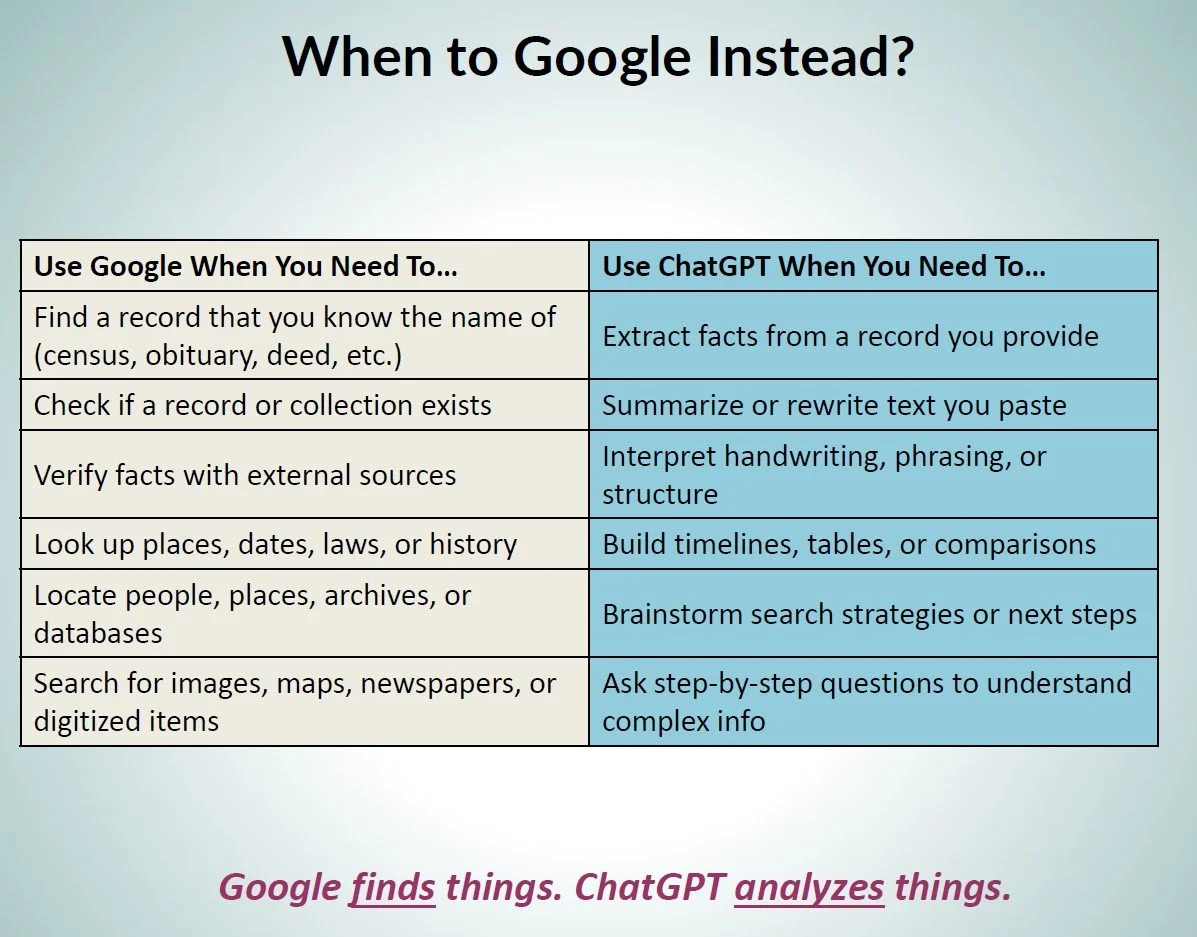
This is a page from my research guide “Fast Start Guide - Using AI for Genealogy” available: https://www.technicalgenealogist.com/shop
BOTTOM LINE
If you are asking AI chatbots to go find your ancestor, you are asking them to do something they simply cannot do. If you use them to analyze what you already have and guide your next steps, they become one of the most useful tools you can add to your workflow.
If you want a clear, practical walkthrough of what to ask AI (and what to stop asking), I put together a basic research guide here: https://www.technicalgenealogist.com/shop
