DNA Results Gave You More Questions Than Answers? Here’s Why
Most people take a DNA test expecting answers.
What often happens instead is the opposite. They end up with more questions than answers.
Unexpected last names appear. Matches don’t connect to the family they know. Relationships show up that don’t make sense. Very quickly, the questions start: who are these people, what does this mean, and what am I supposed to do with this?
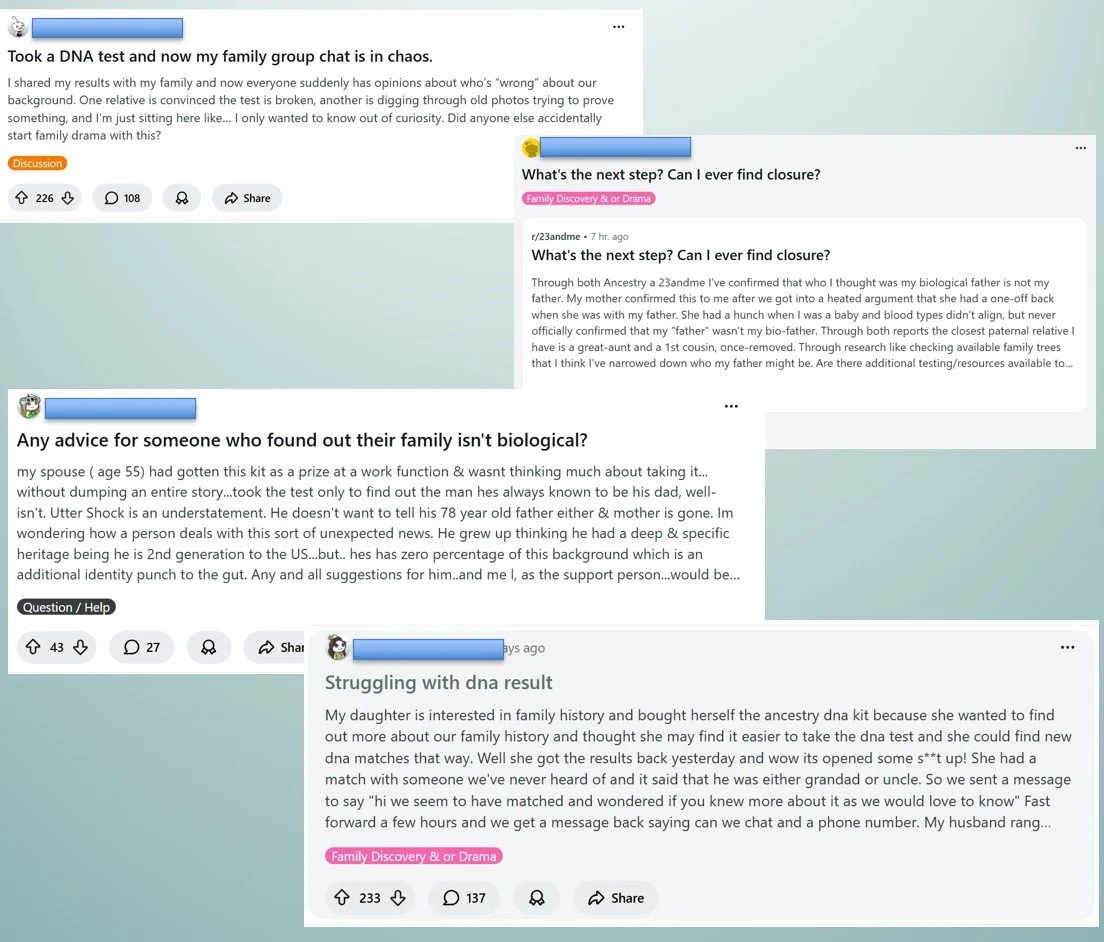
If you spend any time looking online, you’ll see the same pattern. People take a test, get surprising results, and then go searching for help because they don’t know how to interpret what they’re seeing. That’s where most people get stuck.
The Real Problem
For beginners, the difficulty is not the DNA itself, it is the interpretation.
If you’ve never built a family tree, the match list doesn’t give you much to work with. You don’t recognize the names, you don’t know which side of the family they belong to, and you don’t know which matches matter.
Basic questions quickly become blockers. What is a centimorgan? Is 800 cM close or distant? Why are there matches that don’t connect to your known family? Where do you even start?
Most people click around briefly, open a few profiles, and then stop.
What People Expect vs. How DNA Actually Works
A common instinct is to search directly for the person they are looking for.
If someone is trying to find a parent or missing relative, they scan their match list hoping that name will appear. It almost never does.
DNA does not work that way. Instead, what shows up are relatives of that person. Cousins, nieces, grandchildren, and extended family members. These are the people who share DNA with you because they come from the same line.
Without a process, those connections are easy to overlook.
What Actually Moves You Forward
What beginners are missing is not advanced genealogy or complex tools. It is structure.
You need a clear way to define what you are trying to solve, organize what you already know, and use your DNA matches in a focused way.
Once you have that, the match list starts to look different. Instead of random names, you begin to see patterns. Groups of matches fall on the same side of the family, clusters form around shared relatives, and certain surnames and locations start to repeat.
DNA is not a lookup tool. It is a puzzle. You combine what you know, your matches, and basic records to build a picture over time.
A Simple Way to Get Started
For beginners, the goal is not to become a genealogist.
It is to understand what you are looking at, take a few structured steps forward, and avoid common mistakes. From there, you can decide how far you want to go.
This is exactly why I put together a step-by-step beginner guide that walks through this process in plain language. It is designed for people who have their DNA results in front of them but do not know what to do next.
You can find it here:
https://www.technicalgenealogist.com/shop/p/dna-doesnt-lie-how-to-find-the-family-youre-looking-for
