Two Small Clues AI Solves Fast (and Why That Matters)
Most genealogy work is not big breakthroughs. It is small moments where something slows you down.
Two recent examples.
A word you can read… but don’t recognize
In a 1915 Kansas state census, I was looking at my relative’s occupation. He had been listed as a farmer in every census going back to 1860. Then in 1915, something different appeared.
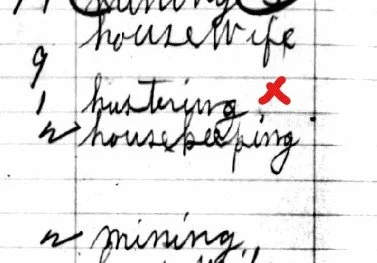
I thought I could read the cursive, but no occupation made sense. Nothing familiar was coming to mind. So I gave AI some context: the man was born in 1846, had always been a farmer, was now living in Kansas, and this was the 1915 state census. I also attached the image.
AI identified the word as huckstering. That is not a term most people use today. It then explained the meaning: selling small goods, often produce, typically as a peddler.
That one step turned a confusing entry into something that actually fit his life story… considering this ancestor was probably selling stolen loot!!!
A phrase you think you understand… but shouldn’t assume
In a 1932 newspaper police report, a client’s relative was listed under the charge “rocking house.” You can guess at what that means, but guessing is how errors enter a tree.
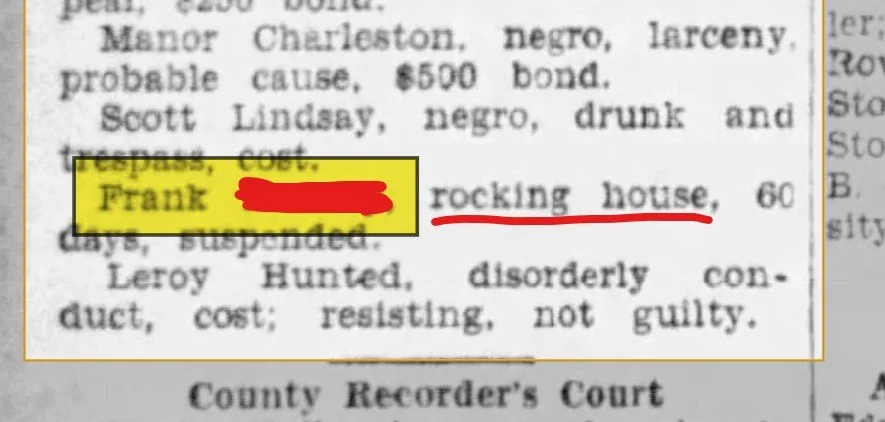
With a short prompt and some context, AI clarified that this referred to a place associated with illicit activity. Not a literal house, and not something to interpret casually.
Why this matters
These are not complex research problems. They are the small friction points that happen constantly:
unclear or unusual handwriting
outdated occupations and slang
regional or time-specific terms
Individually, they are minor. Collectively, they slow research down and introduce risk if you guess wrong.
AI performs well at this layer. It can quickly:
read and interpret difficult text
translate unfamiliar terminology
provide just enough historical context to move forward
It does not replace analysis or proof. You still need to evaluate sources and build conclusions carefully.
But it removes the small obstacles that add up over time. And that is where it is most useful in day-to-day genealogy work.
