Using AI to Transcribe Records of Enslaved People
Historic records can be hard to read. You may be dealing with cursive handwriting from hundreds of years ago, uneven penmanship, antiquated terms, faded ink, worn pages, damage, or records spread across multiple pages. Some are difficult for another reason: they document people who were enslaved and treated by the law as property.
Recently, I worked with five estate record images for Thomas Faver/Favors in Wilkes County, Georgia. The pages included probate details, family names, estate distribution, and the names of enslaved people listed in the estate. I used Gemini (I have a paid version of the tool) to help transcribe and organize the material, then reviewed the results against the original images. I’ve shown one example below.
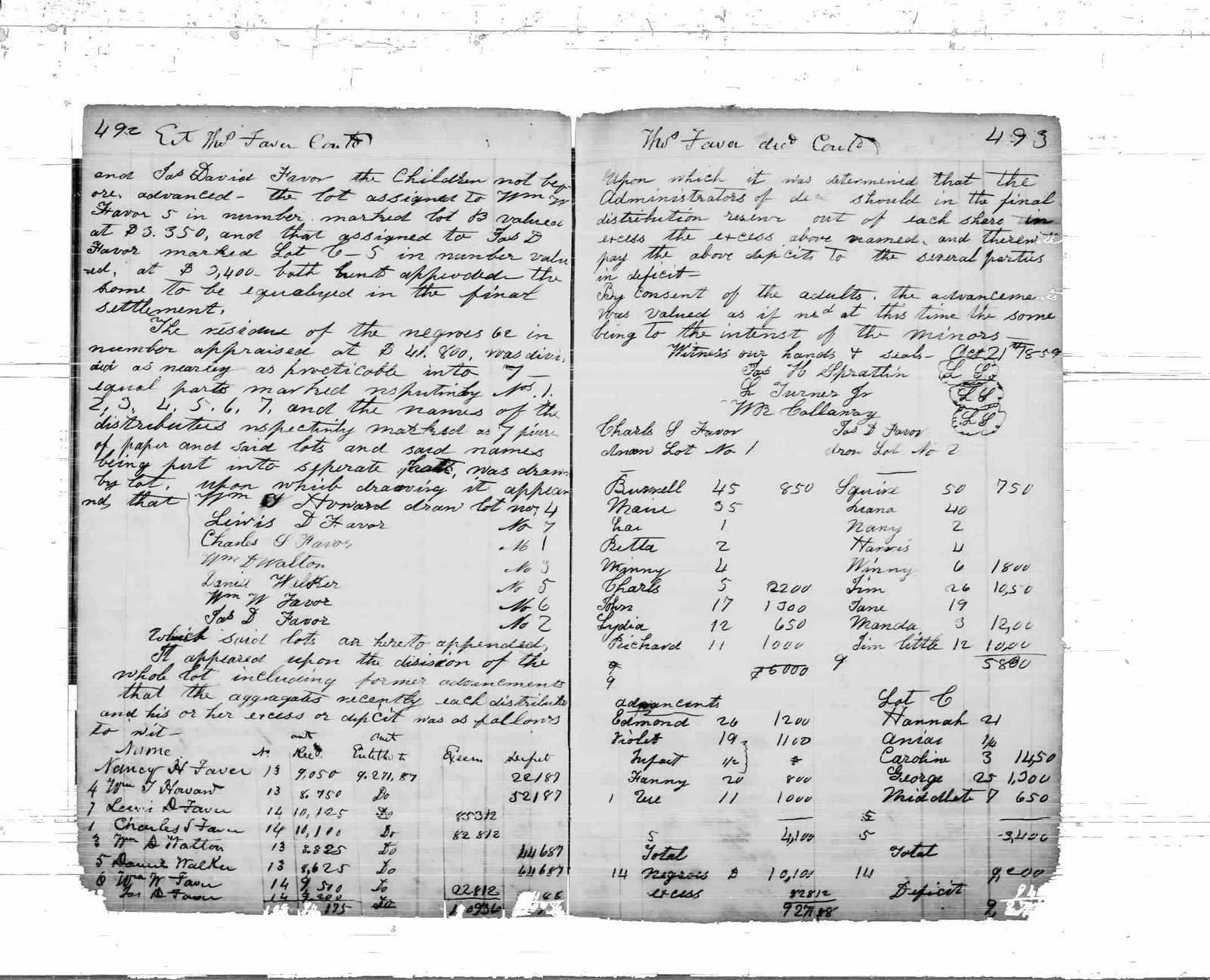
Thomas Faver Estate Records, 1859, Wilkes County, GA
This is where AI can be useful in genealogy. I was not asking it to “solve” the record on its own. I used it as a research assistant for two related tasks: first, to help transcribe a difficult handwritten document, and second, to help manage the data after transcription. Across these five pages, the estate record named 108 enslaved individuals. That is a lot of information to track, especially when trying to compare names, ages, groupings, and possible relationships against a family tree.
I started with broad questions, such as: “Can you make sense of these five documents?” and “Can you list the Favor/Favors heirs and explain who they are?” Then I moved into the most important part of the record: the enslaved people named in the estate.
I asked Gemini to identify the people listed, include ages or other details, and look for specific first names from the family tree I was working on. I also asked follow-up questions about Hannah, Winnie, Burnell, and Squire. That back-and-forth helped me move from a hard-to-read document set into a working list of names, ages, possible groupings, and research questions.
AI can help pull names from difficult handwriting, compare names across pages, create tables, and identify possible family clues. But it can also misread names, confuse ages or values, and infer relationships that are not actually stated. That matters. For many descendants, one name in an estate record may be rare evidence of an ancestor’s life before 1870.
This kind of work also needs care because the records themselves are painful. Estate records often list human beings beside livestock, furniture, tools, and debts. That language reflects the legal system of slavery, not the humanity of the people named. When I write about these records, I try to use “enslaved people” rather than “slaves,” unless I am quoting or explaining the wording used in the original document.
Because the stakes are high, I treat AI as a starting point, not the final word. I ask targeted follow-up questions, instruct the model to double-check its work, and ask for specific page locations showing where information was found. The final step rests with me: I examine the original document myself and validate every claim against the image.
A less careful prompt would be something like, “What slaves are listed?” A better version is: “Please identify each enslaved person named in this record. Include name, age, appraised value, page location, associated estate lot, and any possible relationship clues. Do not assume relationships unless the document clearly states them.”
That last part is important. If several people are listed together, it may suggest a family unit, but it does not prove one. The original record still controls.
As a research check, I am also comparing the document evidence against the family tree and DNA evidence from descendants. For example, when names such as Squire and Burnell appear in the record, I am not relying only on placement in the estate papers. I am looking for whether the proposed relationships are also supported by descendant lines, shared DNA, and traditional genealogical records.
AI helped me read these pages more efficiently, but the goal was not speed alone. The goal was to recover names, preserve context, and treat the evidence with care. In genealogy, especially when working with records of enslavement, every name matters.
